[Outline] Nagano Honzawa onsen @Chino The open air bath Japan highest place, Mt. Yatsugatake Hidden spring directly under Mt. Ioh
" ..."
[Spring quality] A house bath (summer) and an alpine-rose bath (winter): Calcium sodium and sulfur bicarbonate spring PH6.9 60 ℃ Unjyo-no-yu: An acid sulfur containing calcium and sulfate spring 45-60 ℃ Clouded white
[Altitude] About 2100 m, mountains' hot spring
[Environment] Isolated lodging house
[Mountain climbing and sightseeing] Mt. Yatsugatake, Mt. Ioh, Mt. Tengu, a horizontal mountain and Mt. Aka, a Natsuzawa pass, the Yugawa ravine, shakunage gregariousness, a green pond, the Shirokoma pond and a Takamiishi
[Spring quality] A house bath (summer) and an alpine-rose bath (winter): Calcium sodium and sulfur bicarbonate spring PH6.9 60 ℃ Unjyo-no-yu: An acid sulfur containing calcium and sulfate spring 45-60 ℃ Clouded white
[Altitude] About 2100 m, mountains' hot spring
[Environment] Isolated lodging house
[Mountain climbing and sightseeing] Mt. Yatsugatake, Mt. Ioh, Mt. Tengu, a horizontal mountain and Mt. Aka, a Natsuzawa pass, the Yugawa ravine, shakunage gregariousness, a green pond, the Shirokoma pond and a Takamiishi
Feature
It is a hidden spring of the mountains who cannot go if it is located in the highest place as an open air bath also in the height hot spring over 2000 m which Japan does not have in great numbers and you do not walk [ in summer ] for 4 hours or more in winter for 1 hour.However, the approach does not have a steep slope, either, and in a Japanese hemlock and a Shirabiso lignosa, on the right, if it goes for a while, it can enjoy Mt. Tengu and the powerful scene which expects Mt. Ioh to the left.Especially the brave figure of Mt. Tengu from near gate this side was wonderful.Red leaves, a mushroom, and the hidden spring of winter also have exceptional snow in spring in a Hakusan shakunage, the stock in Komakusa, and autumn in the scene of a remain mountain, and summer.It discovers at the time of the Edo last stage and a Bunka-Bunsei.Visit: 2~3 times [ besides 2001/1/16 ], and 2005/7/21
2765 m of Mt. Ioh.
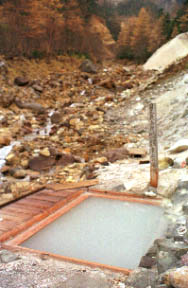
The altitude of 2150 m, the Japanese highest place open air bath "Unjyo-no-yu."
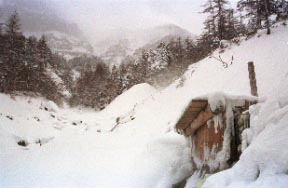
Winter, the alpine rose bath hot water hut into which hot water goes instead of a house bath.
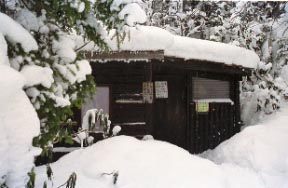
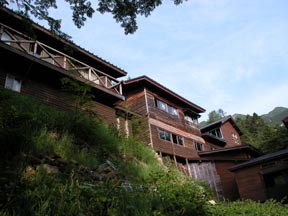
A new building guest room building, back Mt. Tengu
Inside - of a Hakusan shakunage Large stock and a July
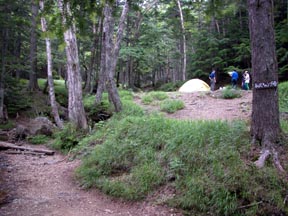
Motosawa camp site
| O It meets with a winter snow car. |
|
|
Period: They are a snow car or jeep by the Heisei 18-year January - a snowy condition. operation: -- reservation required -- ask. Object: Only the direction of train hiking of stay to a Honzawa onsen Climb down to entry: There is no sending off at the time of a climb down to entry. |
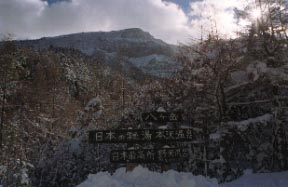
| Motosawa entrance -> honzawa path through a wood -> gate ... A snow car, about 60 minutes Gate -> honzawa ..... On foot, about 1 hour and 30 minutes |
Souce of spring
- House Bath (Summer) and Alpine Rose Bath (Winter) :
- Calcium sodium and sulfur bicarbonate spring PH6.9 60 deg C
- "Unjyo-no-yu" :
- An acid sulfur containing calcium and sulfate spring 45-60 deg C Clouded white
Therapeutic value
High blood pressure, women's diseases, neuralgia, and oversensitivity to cold
Tokyo -> the Asama Shinkansen, Sakudaira station -> Koumi Line, the Komi station
Shinjuku -> Chuo Line, Kobuchizawa station -> Koumi Line, the Komi station
Shinjuku -> Chuo Line, the Chino station
In the case of a taxi :
Komi station -> taxi 30 [ about ] - 40-minute, and Motosawa entrance -> Yugawa ravine promenade about 2 hours (winter is on foot about 5 hours from a honzawa path-through-a-wood entrance)
In the case of a bus
Komi station -> Bus terminal, Inako hot water -> on foot about 2 hours, and green pond -> on foot about 1 hour, and a half -> honzawa
Chino station -> A bus, Mino door alighting -> on foot, and Yamanoko mura -> Mt. Ioh -> Natsuzawa pass -> honzawa
Chino station -> A bus, Mugikusa-pass alighting -> on foot, and Shirokoma pond -> Takamiishi hut -> Mt. Tengu -> Natsuzawa pass (Byakusa new root) -> honzawa
Chino station -> A bus, on foot [ Shibuno-yu alighting -> ], and the Mt. Tengu -> Natsuzawa pass (Byakusa new root) -> honzawa
Reference: Distance to a Yamabiko-sou
Shinjuku -> Chuo Line, Kobuchizawa station -> Koumi Line, the Komi station
Shinjuku -> Chuo Line, the Chino station
In the case of a taxi :
Komi station -> taxi 30 [ about ] - 40-minute, and Motosawa entrance -> Yugawa ravine promenade about 2 hours (winter is on foot about 5 hours from a honzawa path-through-a-wood entrance)
In the case of a bus
Komi station -> Bus terminal, Inako hot water -> on foot about 2 hours, and green pond -> on foot about 1 hour, and a half -> honzawa
Chino station -> A bus, Mino door alighting -> on foot, and Yamanoko mura -> Mt. Ioh -> Natsuzawa pass -> honzawa
Chino station -> A bus, Mugikusa-pass alighting -> on foot, and Shirokoma pond -> Takamiishi hut -> Mt. Tengu -> Natsuzawa pass (Byakusa new root) -> honzawa
Chino station -> A bus, on foot [ Shibuno-yu alighting -> ], and the Mt. Tengu -> Natsuzawa pass (Byakusa new root) -> honzawa
Reference: Distance to a Yamabiko-sou
By car
Joshin-etsu Saku IC->R141, a Komi station -> Matsubarako entranceCentral way Sudama IC->R141, the Nobeyama -> Matsubarako entrance
Central way Kobuchizawa IC-> Mt. Yatsugatake toll road ->R141, the Nobeyama -> Matsubarako entrance
-> honzawa path-through-a-wood entrance via Matsubarako entrance -> Matsubarako (as for winter, a four-wheel drive car is also so far) -> honzawa path-through-a-wood, about 3 km-> Motosawa entrance (also in summer, general car is so far) -> Yugawa ravine promenade, and about 3 km-> gate (four-wheel drive car is also so far) -> about 1 hour, a honzawa